Was CIA's "greatest agent handler" a KGB mole?

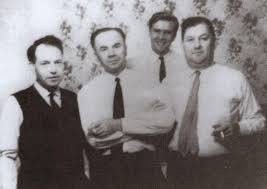
Photo: (l-r) MI6’s Harold Shergold, GRU Lt. Col. Oleg Penkovsky, MI6’s Michael Stokes, CIA’s George Kisevalter. Photo taken by CIA’s Joe Bulik in London in April 1961.
When we compare what former high-level CIA officer Tennent H. Bagley wrote in his 2007 book, Spy Wars: Moles, Mysteries, and Deadly Games, with what former CIA analyst Clarence Ashley wrote about his friend and business partner, George Kisevalter, in his 2004 book, CIA Spymaster, the difference is so jarring that one is tempted to conclude that Russia-born Kisevalter, who is believed by many to have been the CIA’s greatest agent handler, was actually a KGB mole.
Take the subject of CIA’s spy, GRU Lt. Col. Pyotr Popov, for example. Popov began spying for the CIA in late 1952 in Vienna (Bagley helped to recruit him), and Kisevalter soon became his handler. As Bagley points out in his book, there’s strong circumstantial evidence that Popov was betrayed in Washington, D.C., movie houses in January 1957 by his recently-fired-by-CIA Moscow dead drop setter-upper, Edward Ellis Smith, and — in the interest of “source protection” — allowed to continue spying for the CIA until November 1958 when he was secretly arrested by the KGB and “played back” for about a year before being publicly arrested on 16 October 1959 (the same day that Lee Harvey Oswald arrived in Moscow).
The following is only part of what Bagley wrote about Popov in Spy Wars. It’s about some conversations that took place in a Geneva safe house about two weeks before he read the thick file on recent true defector Anatoly Golitsyn at CIA headquarters. When Bagley finished reading the it, he realized that what Nosenko had told Kisevalter and himself a few days earlier had so implausibly overlapped (and contradicted) what Golitsyn had told the CIA six months earlier that Nosenko must have been sent to Geneva to discredit Golitsyn, especially since he and Golitsyn had worked in different departments of the highly compartmentalized KGB.
Note: Although it is true that the KGB watched George Winters mail the (unnecessary) letter to Popov and retrieved it, that’s not how it learned that Popov was a traitor.
Also note that this Substack article is only “the tip of the iceberg” as to what Kisevalter told Ashley that contradicts with what Bagley wrote in his book. A few of the many indications that Kisevalter was a mole are 1) his volunteering intel to Nosenko in June 1962 in Geneva that he had no “need to know” 2) his never “catching on” to the anomalies and contradictions that were popping up in the Nosenko case, 3) the fact that Nosenko “reacted” when he answered “No” to the polygraph question, “Are you hiding anything from us about Kisevalter?” (paraphrased), 4) his supporting Nosenko against Bagley in 1964 (see below), 5) the fact that he “bought” the lame stories of all of the Kremlin-loyal Soviet “defectors” and “double agents” who supported Nosenko’s bona fides, and 6) the fact that both of the major agents he handled — Popov and Penkovsky — were arrested by the KGB and executed.
My comments are in brackets.
Bagley:
In the course of our first meeting with George Kisevalter [in June 1962 in Geneva], Yuri Nosenko told us how GRU Lt. Col. Pyotr Popov was caught.
"It was surveillance,” he said. “Our guys were routinely tailing George Winters, an attaché at your embassy. Some time in early 1959 they saw him drop a letter into a street mailbox. It was written in Russian with a false return address and addressed to Popov. "That was all we needed— diplomats don’t post innocent letters to GRU officers. Popov was put under twenty-four-hour surveillance. Within a few days they followed him to a clandestine meeting with Russell Langelle, the American Embassy security officer. They arrested Popov a few days later, interrogated and got his confession, and ran him for a while as a double agent before closing the operation down. Langelle was arrested moments after Popov handed him some reports the KGB had concocted. As usual in such cases, they tried to recruit him. Langelle refused and got kicked out on his diplomatic ass. Popov was tried and shot.”
Here was poignant confirmation for Kisevalter, who knew that Popov had told the same story in a note he surreptitiously passed to Langelle in the restroom of a Moscow restaurant a month before the fatal meeting.
“Yes,” George told me after the meeting, “Winters did mail that damned letter, and that was never published in the press. This guy really has the inside story.”
. . . . . . .
Ashley mentions Popov on many pages in his hyper-wordy book, but the following is the only substantial thing he writes about him.
My comments are in brackets.
Ashley:
Russell Langelle, who was also an associate of George, came to Berlin and met Popov later in 1958. He was given diplomatic cover, with the ambassador’s knowledge, and dispatched to Moscow. Presumably, if Langelle were apprehended in espionage, he would not be unduly incarcerated. By this time, things at the US Embassy in Moscow were much different.
Evidently, the charade of a fake agent [a chemistry student the CIA had arranged for Popov to “recruit” in order to improve his status at GRU headquarters] for Popov in Berlin was not too good. Under the pretense that his superiors needed to discuss the matter of Popov’s “agent” with him personally, they summoned him back to Moscow that November [of 1958].
He was not too worried about this issue, but he did not know what was in store for him. In December, his wife closed up their household in Karlshorst and went back to Moscow. Popov never came back to Berlin and George never again saw him.
There has always been considerable speculation as to when Popov first came under suspicion by the KGB for disloyalty. In any event, the actual steps in the process of his ultimate arrest are fairly well known. Using the communication plan previously provided to him by George during their last meeting in Berlin, on Christmas Day in Moscow, Popov signaled to Langelle using a “wrong number” phone call*. He wished to meet on 28 December at a children’s theatre in Moscow. He did not show for the meeting, automatically setting up an alternate rendezvous at the Aragvi Restaurant one week later.
The 4 January 1959 meeting went as planned. In the men’s room of the restaurant, Popov passed to Langelle a message that was considered sterling. In it he provided some good intelligence, but he also provided the notice that he had been dismissed from the GRU for disciplinary reasons and was living in Kalinin at his wife’s former home. There was the suggestion that several items, either individually or collectively, played a part in his dismissal. Prominent among them was the affair of the illegal, Margarita Tairova, in New York City with the FBI [Bagley tells us that the Tairova op — in which she fled back to Moscow claiming to have been surveilled by the FBI all the way from Berlin to NYC — was intended to incriminate Popov in such a way that wouldn’t point to the mole who had betrayed him in January 1957]. It may have been a catalyst. Another may have been the suspicion that he leaked the speech made by Marshall Georgi Zhukov in East Germany. Yet another could have been the possible discovery of the false agent provided to him by the CIA in Berlin. Finally, even another may have been Popov’s association with a female Australian agent, “Milli,” whom he purportedly used in Vienna. She cast her allegiance to the Austrians while Popov continued to communicate with her. Popov’s message to Langelle also said that he was in the Reserves anticipating an assignment that he wished to talk with Grossman (George) about. Langelle passed to him a brief message, suggesting that he write to George at a specified address in Berlin and explain what had happened to him.
Popov signaled for a second brush contact to be on 21 January and a familiar bus stop. As a backup to this rendezvous, a letter was mailed to Popov’s Kalinin address. This would ensure that Popov had the information deemed it necessary for further communication if the meeting did not go as planned, say if he were transferred away from Moscow prior to the brush contact. The meeting proceeded, however, and Langelle passed to Popov a message containing the locations and details for some future meetings, some technical instructions regarding their communications, and the advice that he destroy some older materials of their trade.
Throughout much of 1959, Popov had additional brush contacts with Langelle in Moscow, and they passed each other information. Agency operator sensed that Popov no longer was able to provide quality information, but they did not know, exactly, his status. First of all, his messages contained very low-grade intelligence. This was so unlike him. More significantly, the letters were written in a conventional, front-to-back fashion in the notebook that he used. In the past, Popov had always written from the back to the front. This was a dead giveaway that something was wrong, and CIA operatives caught it immediately. Also, Popov did not number his messages as he routinely had in the past. He provided these flags although he was under extreme duress, because, as the Agency people later learned, he was living in a jail cell.
Ultimately, it was confirmed that the KGB had, in fact, observed all of these contacts since the one on 21 January. The Seventh Directorate of the KGB, the one devoted to surveillance, had astonishing capabilities. First of all, they had an Academy in Leningrad where the best agents were trained. They came from Moscow, Kiev, and all over to be trained there. Only the best were selected. They were the officers, not the enlisted men. These were the ones employed against the US Embassy in Moscow. If someone from the embassy left to go to the barber shop, there would be people recruited for positions in the barbershop. If an American were to go shopping, without fail it would be surveilled by other “shoppers.” The surveillers [sic] could be active or retired people. Everybody in the Soviet Union had a job.
Finally, on 18 September, again in the Aragvi Restaurant, Popov appeared in a neatly tailored uniform of the Transportation Corps and bearing the rank of a full colonel. He was able to pass to Langelle what appeared to be a genuine message, in addition to one that obviously was KGB authored. The authentic message was written in pencil on eight small pieces of paper and rolled into a cylinder about the size of a cigarette. (In the future this message would be referred to as “the cylinder message.”) In addition, it was wrapped in cloth, was tied with a string, and carried a pleasant fragrance, like shaving lotion. In this letter, he reported that he had been arrested the previous February and that all of the meetings since had been under KGB control while he was wearing a microphone. The letter revealed the extent to which the KGB did and did not know of Popov’s actual cooperation with the CIA. It revealed some technical errors that the KGB had made in its analysis of his situation. It described the KGB plans for future meetings between him and CIA people. It indicated that there was a high likelihood that his interrogators thought he might be the source of the leak of Marshall Zhukov’s speech.
The validity of the 18 September “cylinder massage” was discussed at length in the chambers of the CIA’s Clandestine Services Directorate. At first, it was considered impossible that Popov had smuggled such an item from, for instance, Lubyanka Prison. Moreover, the message itself adds suspicious elements. It had been written throughout with sharp pencil. Would Popov, while incarcerated, have access to numerous sharp pencils or a pencil sharpener? How could he have written such a complete message without having been observed at some time in the process? Yet there were aspects to the letter that indicated Popov and only Popov was its author. Perhaps his incarceration was more benign than it otherwise could have been. Perhaps he was still successfully playing games with his masters. Ultimately, the conclusion was that the letter was genuine. It was much too reflective of Popov’s personality to have been a ruse.
George’s description of the 18 September Aragvi Restaurant meeting follows. “Well, this long story has a sad and illuminating ending. Noy only does it illustrate Popov’ ability to execute a most incredible act in the art of clandestine tradecraft, but it also demonstrates the sad, simple naivete of the man, in that he had so much faith in the propensity of people to do the right thing. Eventually, after they thought they accurately understood his relationship with us, the KGB tried to set him up as part of a gimmicked, double agent, controlled operation. They planned a meeting between him and Langelle in which they endeavored to have him pass more lousy information. However, during the time that he was in jail, he had meticulously, over months, constructed his own message. First, he cut his finger until it bled profusely and had a bandage put around it. Then, he removed the bandage, placed the message against his finger, and reinstalled the bandage. In the middle of the controlled operation, in the men’s room of the Aragvi Restaurant in downtown Moscow, completely covered by the KGB watching, our man Langdale and Popov shook hands. Popov then slipped the bandage from his finger and gave the note to Russell. This was undetected by the surveilling KGB.”
Although the successful pass of the cylinder message might have given hope that some productive use of Popov might still be possible, a month later on 16 October, a brush meeting between Popov and Langelle on Moscow bus 107 was abruptly and prematurely terminated. Langelle was detained and then sent home persona non grata. Popov was seized and scheduled to be put on trial before a military collegium on 6 January 1960. [Footnote #1]
George continued, “When I finally received [the cylinder message] and deciphered it, word by word, it caused me to cry. This was a rare jewel, a genuine Prince. The note gave us some meaningful intelligence as well as the admonition that the American Embassy in Moscow was completely surveilled. In part, the note sought to confirm to us the fact that he was under control of the KGB and had been since February [1959]. Finally in the note he pleaded, “Could you not ask your kind President Eisenhower to see if he might cause restitution to be made for my family and my life?”
[Footnote 1] The foregoing was constructed from conversations with numerous people including George, Yuri Nosenko, Leonard [V.] McCoy, and others who wish not to be mentioned. It was further authenticated with documents provided to the author by the CIA. These included excerpts from declassified articles entitled, “The Popov Case,” undated. For additional descriptions of the steps in the ultimate apprehension of Popov, see Battleground Berlin (New Haven; Yale University Press, 1997), 279. The authors, David E. Murphy (former chief of Berlin Base, Sergei A. Kondrashev, retired Lieutenant General of the KGB and former head of its German Department), and George Bailey (reporter and former director of Radio Liberty), cite newly provided KGB source material.
. . . . . .
My comments:
You can read Bagley’s Spy Wars for free by googling “spy wars” and “archive” simultaneously, and you can read Ashley’s CIA Spymaster for free by googling “cia spymaster” and “archive” simultaneously.
*This “wrong number” phone call sounds suspiciously like the two speechless phone calls an American Embassy employee received in Moscow on Christmas Eve 1961. Said phone calls, three minutes apart, so closely resembled the calls Kisevalter had instructed Oleg Penkovsky a couple of months earlier in Paris to make in case of an emergency as to cause Embassy Security Officer John Abidian to check (in vain) Penkovsky’s dead drop a few days later. In Spy Wars, Bagley writes about this incident and the devastating ramifications it had on Nosenko’s “legend” in 1964.
Tellingly, in 1964 Kisevalter backed Nosenko’s “memory” against Bagley’s regarding whether or not Nosenko had told them in 1962 that his KGB crew had watched Abidian “set up” Penkovsky’s dead drop in late December 1960, when in fact the only thing Nosenko had said about Abidian in 1962 was that his surveillance crew had found a pair of girl’s panties in his bedroom. Bagley points out that Penkovsky had set up the dead drop, himself, before he was recruited by MI6 and the CIA, and that the only time Abidian was in physical contact with it was in late December 1961, right before Nosenko transferred to the Tourist Department and therefore wouldn’t have been privy to the three months of dead drop monitoring reports he claimed to have read even if he had confused December 1961 for December 1960 (he was adamant that he hadn’t).
Although Bagley and Kisevalter worked together and the former was Nosenko’s primary case officer from June 1962 to September 1967, Ashley refers to him twelve times as “the other case officer” instead of by name.
Food for thought:
Former high-level Army Intelligence analyst and NSA officer John M. Newman says in his 2022 book, Uncovering Popov’s Mole (which he dedicated to Bagley) that Bagley’s mole, Smith, may have simply helped another possible mole, the Office of Security’s Bruce Leonard Solie. Newman believes Solie betrayed Popov and leaked the U-2 spy-plane’s specifications to the KGB in those D.C. movie houses, and that he, as James Angleton’s confidant, mentor, and mole-hunting superior, may have been able to relay to Nosenko’s boss in Moscow — via moles in French Intelligence and a highly mobile KGB officer by the name of Mikhail Tsymbal — what Golitsyn had told Angleton so that Nosenko’s “legend” could be tailored before he “walked in to” the CIA (in the form of Bagley and Kisevalter) in Geneva in June 1962.